








THE RISING RESTORER
You are getting sleep. But your body is not finishing the work. Here is exactly why — and what changes it.

YOU'RE NOT SLEEP DEPRIVED. SO WHY DO YOU FEEL LIKE IT?
You are not sleep deprived. Not technically.
You go to bed at a reasonable time. You get your seven, maybe eight hours. You do not feel terrible. You function. You get through the day. You do the things.
But there is this feeling — subtle, persistent, hard to name — that sleep is not quite doing what it is supposed to. That you should be waking up feeling better than you do. That your skin should look less tired. That afternoons should not require this much effort.
You have probably Googled it. Why am I tired even after 8 hours of sleep. You found some articles about sleep hygiene. You tried going to bed earlier. Maybe you cut the screens down. Things got a little better. But not the way you were hoping. Here is what no one told you: the problem probably is not how much you are sleeping. It is what is interrupting the cycles while you sleep.
And the culprit is almost certainly not what you think it is.
THE MOST COMMON CAUSE OF UNRESTORATIVE SLEEP IS NOT MENTAL. IT IS THERMAL.
Most people blame their brain for bad sleep. The thoughts. The to-do lists. The 11pm anxiety spiral.
But here is what the science actually shows.
Your body needs to drop its core temperature by 1-2°C to initiate and maintain deep sleep. It uses your skin as the primary heat exchange mechanism to achieve this. When that exchange is working properly — when air can move freely across your skin and heat can escape — your body hits the deep sleep threshold and stays there. When it cannot? You cycle up into lighter sleep. The deep stages are cut short. Growth hormone is reduced. Cellular repair is incomplete. Cortisol clearance is partial.
In the morning, you feel it. That familiar sense that sleep happened, but the work did not quite finish.
The good news: this is one of the most fixable things in sleep science. And it often shifts within nights, not weeks.
Natural fibres. Designed to release heat, not trap it.
THE DIVING EXPEDITION YOUR BODY IS TRYING TO COMPLETE
Imagine your sleep cycles as a series of diving expeditions.
Each night, you make four to five dives. The first dive — about 90 minutes in — is your deepest and most restorative. This is where growth hormone peaks, where your skin does its most profound cellular work, where your nervous system reaches its deepest level of recovery.
For a Rising Restorer, you are making the dives. But something is pulling you back up before you reach the bottom.
It is subtle. You do not always feel it. But overnight, your body temperature creeps upward — from fabrics trapping heat, from a room that is slightly too warm, from a nervous system that never fully downregulated before you got into bed. As your temperature rises, your sleep architecture responds. You cycle upward. You enter lighter stages. The dive ends early.
Multiply that across five sleep cycles, seven nights a week, and you start to understand why your mornings feel the way they do.
Your body wants to dive deep. It has been doing this your entire life. It just needs the conditions to get there and stay there. Remove the thermal friction. Support the microclimate. Give your nervous system the signal that it is safe to release completely.

THE FRICTION IS REMOVABLE
Your body already knows how to restore. It has been trying every single night. The checklist below is about finding the friction and removing it — so the dives can finally finish.
THE RISING RESTORER CHECKLIST
You do not need to rebuild your entire sleep life. You need to find the friction and remove it. Tick these off as you go.
-
Check your bedroom temperature. Aim for 16-19°C. If it feels cool when you get into bed, that is exactly right. If it feels comfortable, it is probably too warm.
-
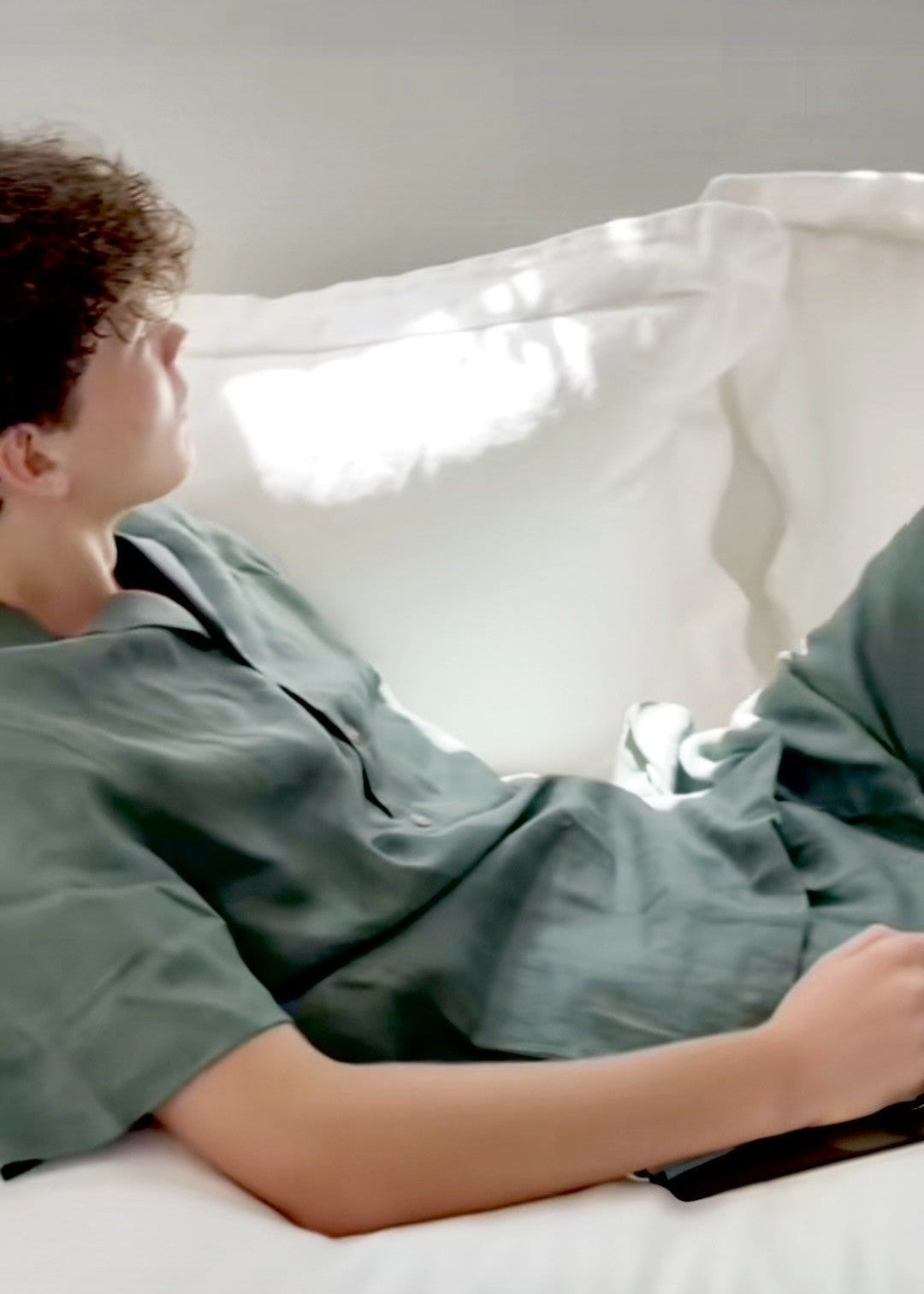
Notice what you are wearing to bed. Are your fabrics breathable? Do they allow heat to escape, or trap it against your skin? Synthetic fibres hold heat. Natural fibres release it.
-
Build a 20-minute wind-down before bed. Lower the lights, move away from screens. Give your nervous system a clear signal that the day is actually over.
-
Move your last coffee to before 2pm. Caffeine has a 5-7 hour half-life and is likely still measurably in your system at midnight.
-
For three mornings, notice exactly how you feel in the first 10 minutes. This is your most direct readout of what happened overnight.
-
Pay attention to when you wake in the night. If it is consistently between 1am and 4am and you are warm, temperature is your answer.
-
Notice your skin on mornings after different nights. The mirror is one of the most reliable readouts of sleep quality available to you.
-
What are you wearing to bed? Natural or synthetic? Fitted or relaxed? The answer to this single question is often the biggest lever available.
-
What is your bedroom temperature overnight? Too warm disrupts cycles more than almost anything else. A thermometer is a worthwhile investment.
-
What is happening in the 60 minutes before you sleep? Screens, stress and bright light all delay the melatonin rise that initiates deep sleep.
GO DEEPER
Each of these pages goes further into the science behind your profile.
WHY YOU WAKE AT 3AM
The thermal explanation for the most Googled sleep question of the last decade — and what to do about it.
THE SLEEP ENVIRONMENT AUDIT
A full breakdown of what is supporting your sleep and what is working against it.
NATURAL FIBRES AND SLEEP QUALITY
The peer-reviewed science on how fabric thermoregulation directly impacts deep sleep stage duration.
WHY WHAT YOU SLEEP IN IS THE LEVER MOST PEOPLE OVERLOOK
You have probably spent money on a good mattress. Maybe a weighted blanket. A white noise machine. A sunrise alarm clock. All of those things can help.
But most people overlook the 7-9 hours their skin spends in direct contact with fabric. Every single night. That contact is either actively supporting your body's thermal regulation — or working against it.
- European flax linen and organic cotton breathe and release heat all night
- Natural fibres allow the airflow your body needs to maintain the cool microclimate
- Supports the temperature drop that keeps you in deep sleep rather than cycling up
- Zero polyester, zero synthetic blends that trap heat against your skin
- Freedom Fit silhouette removes restriction that keeps the nervous system activated
- GOTS certified organic cotton
For a Rising Restorer, this is likely the most direct environmental change available to you. And the feedback is usually fast.
Explore the Collection
REMOVE THE FRICTION. TONIGHT.
Your body already knows how to restore deeply. Give it the conditions to finish the work.